OVERVIEW
The uSDX is a credit card-sized fully operational HF radio capable of modulating SSB (USB and LSB), as well as CW. There are multiple versions of this project. This one was created by Manuel, DL2MAN, and the software originally by Guido, PE1NNZ. I also built one of the other original versions by Barb, WB2CBA.
THE BUILD EXPERIENCE
This is one of my favorite open source projects to date, as the community was quite small and I was able to help, as well as be helped, by others. A lot of knowledge and experience was shared.
Specifically, a problem arose where a number of people were receiving ATMEGA328P microcontrollers without bootloaders. I made a guide for them to successfully load the bootloader onto their microcontroller via the command prompt, using a breadboard and USB-ASP. This then allowed them to upload the uSDX firmware via their Arduino's.
TECHNICAL CHALLENGES
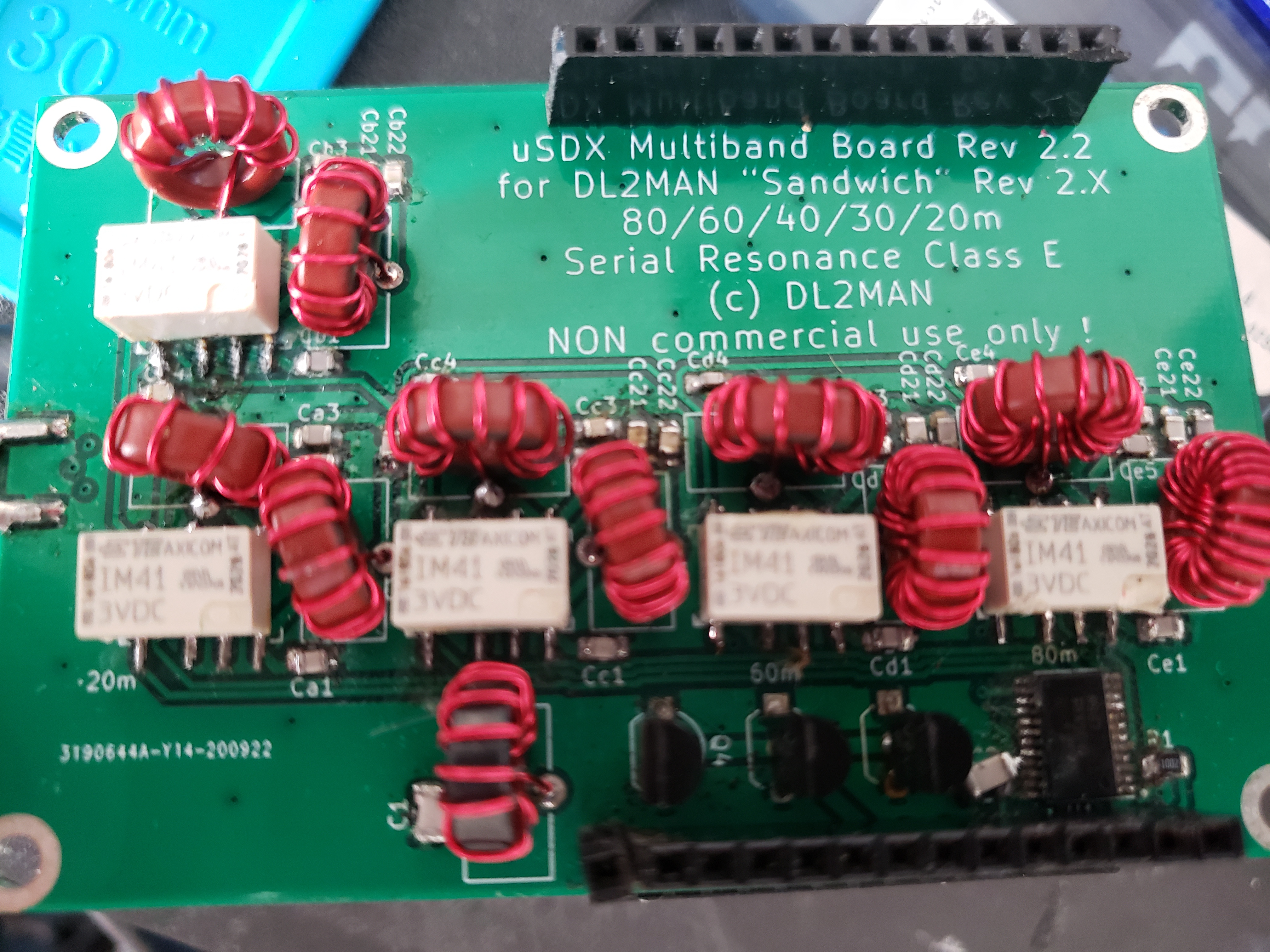
This project consisted of many parts, and was a great learning experience. The RF filter board was especially interesting, as it was my first introduction into Class E amplifiers and serial resonance. This made it quite a challenge, but was extremely rewarding, as the values for each frequency band had to be optimized while maintaining that optimization for all.
I did this using a VNA and LC Meter. The board was designed by Manuel, DL2MAN, to allow for five frequency bands, and each pair of toroids had to be tuned to the correct frequency band, which was done by changing the number of times the magnet wire was wrapped around the toroid, as well as the capacitor values.
KEY FEATURES
Multi-Mode Operation
Supports SSB (USB/LSB) and CW modes for versatile HF communication.
Class E Amplifier
Efficient Class E amplifier design with serial resonance for optimal RF output.
Five Band Coverage
Tunable filter board supporting five HF frequency bands with individually tuned toroids.
Compact Design
Credit card-sized form factor making it highly portable for field operations.
LEARN MORE
If you're interested in learning more about the uSDX, the uSDX Groups.io page is a great place to start. The community is welcoming and there's a wealth of information about building, modifying, and operating these radios.